

Engineering Engagement: Strategic Ambiguity and Controversy-Bait

On Saturday morning, while browsing Facebook, I came across this post.
![A composite screenshot with two panels. The left panel shows Jim Walsh's original Facebook post from seven hours prior. The image is a selfie of Walsh — a white, middle-aged, bald man in a dark suit — looking at the camera with a neutral expression. He fills the lower-left foreground of the frame. Behind him, hundreds of attendees at the Kent Sikh Day Parade are visible, many wearing colorful traditional clothing, including many head coverings; white event tents are visible in the background. The post caption reads: "If you want to fix what's broken in WA, you need to go where the people are. Kent." The post has 1.3K reactions, 836 comments, and 84 shares. The right panel shows a selection of comments with names and profile pictures redacted. They include: "Islam needs to be banned!" "DiVeRsItY iS oUr StReNgTh" followed by a trash can emoji (mocking the phrase) "Looks more like Mogadishu." (5 reactions, mix of likes and angry) "Is this what was the 'Muslims Only' gathering?" "I love that Kent is so diverse ♡" "CALL ICE!!! [American flag emojis] DEPORT ALL ILLEGAL ALIENS [American flag and heart emojis] I want my country back!" "Ew why are you even on my fyp?"](https://substackcdn.com/image/fetch/$s_!AYNq!,f_auto,q_auto:good,fl_progressive:steep/https%3A%2F%2Fsubstack-post-media.s3.amazonaws.com%2Fpublic%2Fimages%2F5279be24-c272-45d2-acb3-c6a1a4daee33_1936x950.png "A composite screenshot with two panels. The left panel shows Jim Walsh's original Facebook post from seven hours prior. The image is a selfie of Walsh — a white, middle-aged, bald man in a dark suit — looking at the camera with a neutral expression. He fills the lower-left foreground of the frame. Behind him, hundreds of attendees at the Kent Sikh Day Parade are visible, many wearing colorful traditional clothing, including many head coverings; white event tents are visible in the background. The post caption reads: \"If you want to fix what's broken in WA, you need to go where the people are. Kent.\" The post has 1.3K reactions, 836 comments, and 84 shares. The right panel shows a selection of comments with names and profile pictures redacted. They include: \"Islam needs to be banned!\" \"DiVeRsItY iS oUr StReNgTh\" followed by a trash can emoji (mocking the phrase) \"Looks more like Mogadishu.\" (5 reactions, mix of likes and angry) \"Is this what was the 'Muslims Only' gathering?\" \"I love that Kent is so diverse ♡\" \"CALL ICE!!! [American flag emojis] DEPORT ALL ILLEGAL ALIENS [American flag and heart emojis] I want my country back!\" \"Ew why are you even on my fyp?\"")
It’s a selfie of Jim Walsh, a GOP member of the state House of Representatives and the chair of the Washington Republican party. Walsh is pictured with a neutral expression, squinting slightly at the camera. Behind him is a gathering of hundreds of people of Indian descent, most of them wearing colorful clothing — including head coverings — associated with the Sikh faith. Walsh appears to be one of very few, perhaps the only, white person in the image.
The caption says, “If you want to fix what’s broken in WA, you need to go where the people are. Kent.”
Superficially, the image and text are ambiguous. Walsh could indeed be campaigning in Kent this weekend and this post could be an honest effort to highlight his outreach with the Sikh community there. That would be a generous read. A quick glance at the comments to this post suggests there something else going on. Let me offer my perspective, one based on a growing body of research at the intersection of online systems and visual propaganda.
Anti-Immigrant Visual Propaganda: The Replacement Frame
In a project led by PhD student Nina Lutz, my research team at the University of Washington has been studying anti-immigrant propaganda within online videos and images. Visually, Walsh’s selfie echoes one of Nina’s findings: that large numbers of immigrants featured in online images are often viewed, especially by conservative audiences, as a threat, seen as outnumbering “true” (read: white) Americans and diluting their cultural and political power. This is the core message of “The Great Replacement” theory, a white nationalist conspiracy theory that has fueled racism and anti-immigrant sentiment here in the U.S. and around the world. The Great Replacement theory — and the broader anti-immigrant ideology that has coalesced around it — runs counter to the foundational story of the United States as a country built and strengthened by immigrants. It provides a powerful, xenophobic frame through which many people view online content that features crowds of people of non-European heritage who can be perceived to be immigrants. And indeed, it appears that many members of Walsh’s audience interpreted his selfie through this frame.
(If you recall, frames are mental structures that shape how we, as humans, make sense of our experiences and interpret data about the world.)
Comments Reveal the Implicit Frame
Though Walsh’s image and caption are superficially ambiguous, the comments on his post show that his audiences perceived an implicit anti-immigrant frame. Many of the comments, especially early on, reflected negative views on immigration generally, specific groups of immigrants, and Muslims in particular — with hostility toward Muslims revealing a misidentification of the Sikh head coverings in the image. Some of the comments were truly horrifying, weaving together racism, xenophobia, and anti-immigrant bigotry. There were calls to ban Islam, deport immigrants, and “take our country back.”
This call-and-response dynamic, where comments on an influencer’s posts reveal the underlying frame, is one my team has documented in the past. Savvy influencers use this kind of implicit framing to invoke specific interpretations and/or emotional responses (e.g. outrage) in their audiences without having to take responsibility for making explicit claims.
This is similar to the concept of a dogwhistle, where only targeted audiences can hear a coded message. Except here, Walsh’s supporters were not the only ones to perceive an anti-immigrant frame in his post.
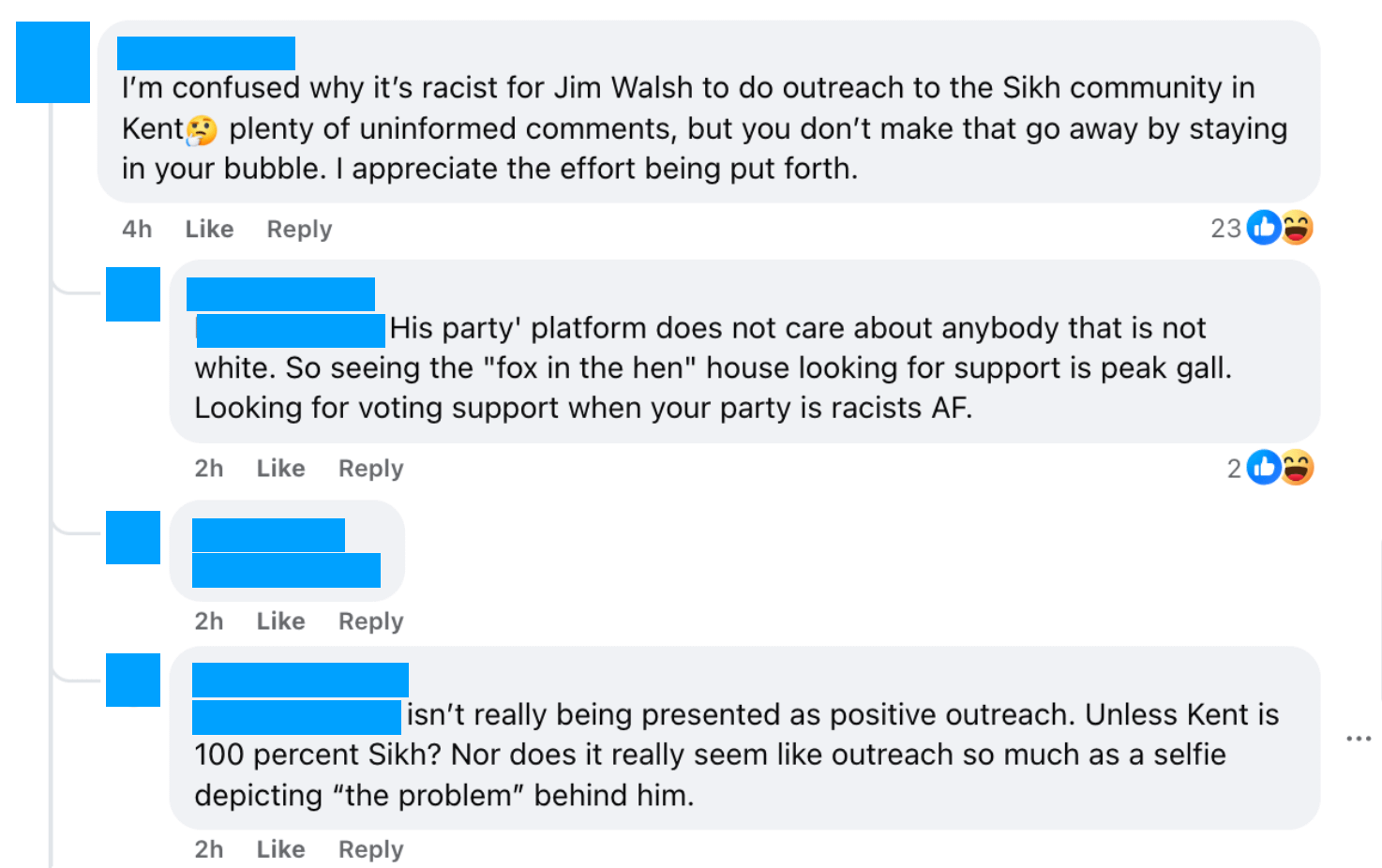
Over time, an increasing percentage of commenters called out Walsh for alleged bigotry, with some of those pointing to anti-immigrant responses as evidence of his intentions. Later, a few commenters defended him against those allegations, claiming that his post wasn’t anti-immigrant. One prominent comment explained that Walsh had been invited to the event by members of the Sikh community.
Ambiguity as Strategy
Interestingly, Walsh’s original post was missing that fact and other key context. His selfie was taken at the Sikh Day Parade, a religious and cultural event celebrating Sikh heritage. It wasn’t a random day in Kent but a gathering of tens of thousands of Sikh people from around Washington state, many of whom wore traditional clothing in honor of the event. This context may have nudged users towards seeing the image through a lens of celebrating immigrants (rather than one of fear and replacement), but Walsh failed to mention that context in his post. The ambiguity allowed for different interpretations and for a controversy to develop around what he did and did not mean. That controversy drove engagement.
Controversy as Engagement
Walsh’s Sikh selfie received substantially more engagement than most of his Facebook posts. By Monday afternoon, it had garnered 1500 comments and nearly 2000 reactions. Many of those comments reflected emotional reactions, from fear of immigrants taking over America and celebrations of immigrant crack-downs to indignation at Walsh for perceived anti-immigrant bigotry to outrage at liberals for labeling Walsh a bigot. Walsh’s post managed to foster emotional reactions — much of it outrage — in several distinct audiences for different reasons. Those reactions reflect an almost perfect mixture of ragebait and controversy, tailor-made for reward by Facebook’s algorithmic recommendation system.
If audiences engage with the post because they like its implied anti-immigrant messaging, Walsh wins. If audiences engage with the post to counter his anti-immigrant messaging, he also wins. If audiences engage in order to fight about what he meant or didn’t mean by the post, again, he wins. Our engagement — via reactions and comments and even just lingering longer on his post — feeds his status within Facebook’s algorithms and means that we and more people like us will continue to see his content and more content like his in the future.
My Take on Walsh’s Post
It is impossible to determine exactly what Walsh’s motives were. We can’t know what was in his head or his heart when he posted this selfie. We can’t know if the call for bigotry heard by some among his audience was intentional. We can’t know for sure if the ambiguity was strategic. But we can point out that Walsh did engage with at least one of the comments, but he did not take any action (that I’ve been able to find) to clarify the intent of his post.
Walsh is an active content producer on Facebook who is clearly trying to use the platform to garner attention and leverage that attention for his political goals. He has effectively maneuvered his content to the top of my feed for a second time, so kudos to Walsh on that. In the case of his Sikh Parade Day selfie, my opinion is that Walsh strategically employed ambiguity to foster outrage and controversy, garnering attention, further polarizing audiences, and ensuring that all of us will receive more of his content — and more content like his — in the future.
Doesn't seem ambiguous to me. He's frowning, the title is "what's broken in WA" and all the people in the background are talking to each other and ignoring him. A normal picture would include his hosts and mention the event.
He doesn't mention "what's broken" when visiting friends:
https://www.facebook.com/permalink.php?story_fbid=pfbid021BbqXNUxznomo78Kk6ZSdGL4yx1HnCaeoKXPUiBDaB9BheFeRZYfmXXTr3LV2yuRl&id=100052932638292
Great analysis, especially looking at comments to get at the intent. I have a couple of questions: (1) When you say "Walsh wins," obviously he wins at the social media game of producing engagement and gaining attention but does he _win_ anyone not already on his side? Are you seeing any evidence of that and I'm curious also how such evidence might be found. (2) I suspect this engagement farming mechanism exists on the left as well but does it differ in terms of topics or engagement strategies?