

Captured by the Crowd: The Hidden Risk for Athlete-Influencers

If you’re a WNBA fan who spends any time online (and maybe even if you’re not), you’ve likely seen content this year featuring WNBA players as characters within political discourse — with some players voicing strong and, in some cases, troubling political stances.
I’m going to resist the urge to name names here and weigh in on the politics around those stances. I’ll save my thoughts on that for other forums. And I am definitely not a “shut up and dribble” kind of person. I think it is important for people with platforms to use their megaphones to voice their opinions for positive change. But I want to highlight something I am seeing that I think is important for athletes, teams, and leagues to understand at this moment: athletes and other celebrities being worked and in some cases “captured” by their audiences.
My research team has long studied how rumors and conspiracy theories take shape and flow through online spaces. In the past, we’ve studied these dynamics around crisis events, conflict, and elections. More recently, my team has been working on a project, led by PhD students Adiza Awwal and Nina Lutz, looking at visual representations of WNBA players on Facebook and Instagram. This work is in an early stage and I can’t yet share much of our findings.
There’s one dynamic that I’d like to draw attention to, though, because it is so salient in my own social media feeds at the moment, and because it lines up with other research in my lab, led by PhD student Joey Schafer, looking at how influence flows online — not just from the top down, but also from the bottom up.
If you’ve been following the discourse around conspiracy theories and online radicalization, you may have heard about the risks of “going down rabbit holes.” The idea there is that a person might encounter a piece of content online that makes them curious about a conspiracy theory — let’s say, UFOs or flat earth theory or child trafficking through furniture ads — and then the algorithms start feeding them more and more of that kind of content, leading them to increased belief in that conspiracy theory and exposure to other problematic content. There’s a similar proposed pathway for political radicalization.
This model, though a bit too simplistic, helps explain how many individuals become radicalized online. But it’s a model for understanding the pathway for everyday people. Our sense is that there are different — and perhaps more interesting and societally impactful — dynamics at play for individuals with large online audiences.
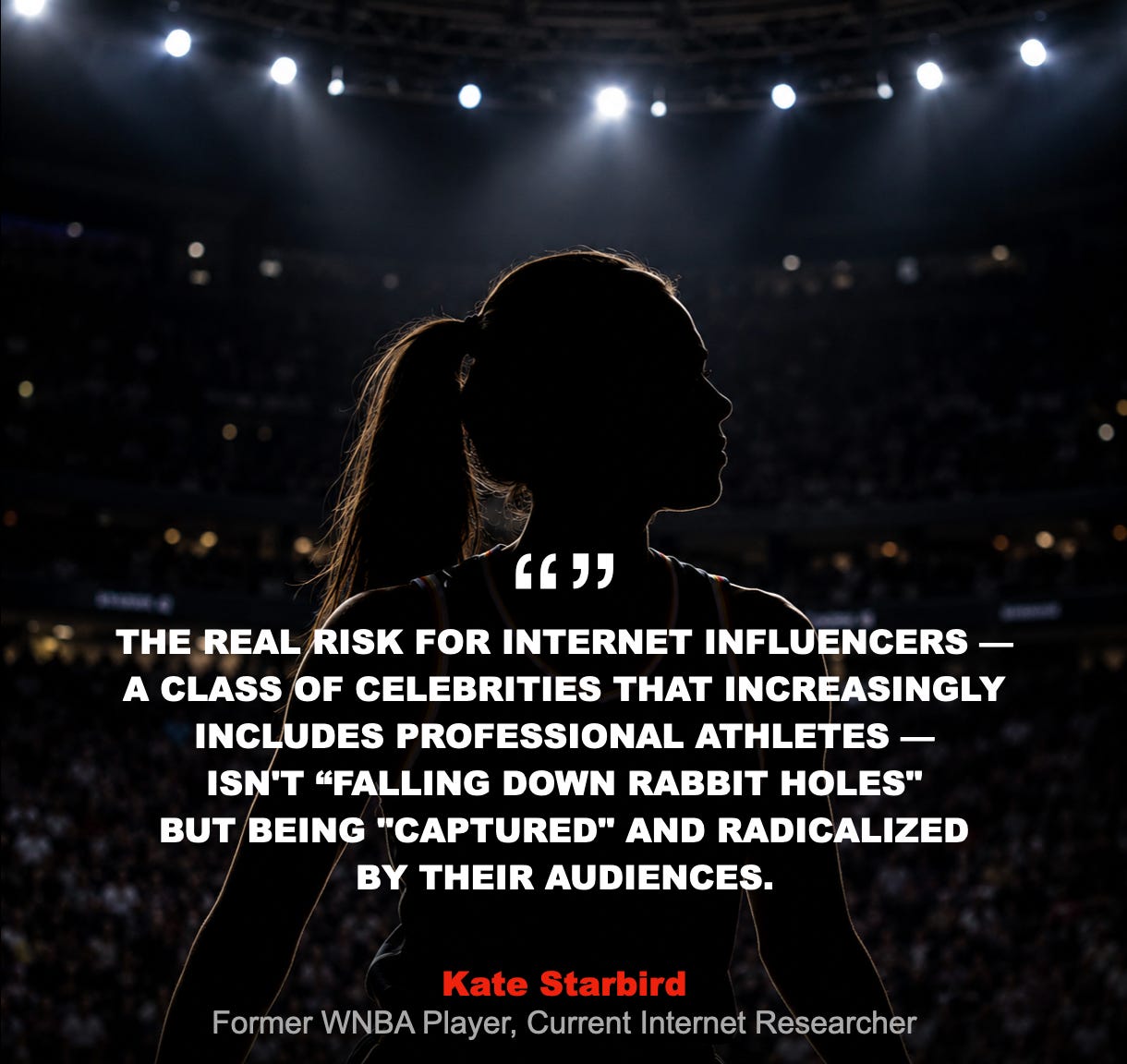
The real risk for internet influencers — a class of celebrities that increasingly includes professional athletes — isn’t “falling down rabbit holes,” but being “captured” and radicalized by their audiences.
As they grow their audiences online, influencers tune into how their followers respond to their posts. They check view counts and reshares. They look at the reactions. They read the comments. And they adapt their content around those signals, creating more of what they think their audiences like, as well as what their audiences will engage with and react to.
Influence doesn’t just flow out from the celebrity-influencers to their audiences. It also flows from the audiences back to the influencer. My colleague Danielle Tomson and I have previously described these interactions between influencers and audiences as improvisational performances, where the influencers are closely tuned into their crowds, adapting their performances as the show unfolds.
In our politically polarized online environment, influencers are a prime target of political persuasion. Audiences can reach them directly, and they know the influencers are listening. And savvy followers understand that they can amplify their messages by getting uptake from an influencer. We’ve seen this dynamic at work with mega-influencers, including President Trump and Elon Musk. But it works on other kinds of influencers as well.
Influencers have a lot to gain by tailoring their performance to their crowd’s preferences, but at the same time, they risk pushing that performance into places they didn’t intend to go, taking on views they previously didn’t have, and becoming caricatures of themselves.
I am seeing this dynamic at play around WNBA athletes — audiences working to nudge athletes into increasingly strong political stances. These efforts have been more successful in some cases and less successful in others.
I don’t mean to question the sincerity of any specific athlete’s beliefs. I’ve studied and understand well enough how political messaging can lead to sincere belief, which can become deeply held. But there are forces at play in shaping those beliefs — and I think it’s valuable to call them out. If you’re an athlete, coach, general manager, or someone who supports athletes in curating their online image, I strongly encourage you to understand what “audience capture” is and reflect on how athletes are especially vulnerable to these dynamics in our digitally mediated information space.
I used to believe sport could offer an interesting space for studying these dynamics through a (somewhat) apolitical lens. But it seems that ship is sailing away into the distance. And it must be exhausting for the players. As if it weren’t already hard enough sustaining energy and health throughout a long season.
Also: Sensetaking. Or another word that can illuminate and operationalize how an athlete’s autonomy and voice is usurped over time. How their mental aperture/ perspective is narrowed (their definition of “truth” or fairness, for example). Narrow apertures strain relationships. And that strain is going to impact elite athletes in deeper and more complex ways than everyday people or Avocado Guys, because athletes must fit into the social and cultural norms of their team/league/sport in addition to negotiating the pulls from their audience.
You can see SC negotiating this tension: “I think I am here to extend love (i.e., I need to fit with my league’s cultural norm of inclusivity) “But I also think love it truth” (my audience is acculturating me to norms of exclusion, so I’ll adopt these words of benevolence to make it feel ok). The cognitive dissonance is palpable. And it’s all happening so quickly... there’s likely little to no awareness of all that’s being taken away.
Thank you Adiza, Nina, Joey, and Kate for the work.